
The Constable Beene Case: Facts Often Left Out
January 22, 2026
Staff Reporter
RUSK, Texas — As the criminal trial of Cherokee County Precinct 4 Constable James “Jamie” Beene begins this week, public attention has once again focused on the 2021 motorcycle incident that led to his indictment. Much of the coverage has framed the case around “policy violations” and use-of-force concerns. But a closer look at the actual record reveals a far more complex case — one shaped as much by procedural failures and omitted context as by the incident itself.
What follows is a full, fact-based timeline intended to give readers a clearer picture of how this case unfolded and why it remains controversial in Cherokee County.
The 2021 Motorcycle Pursuit and Crash
On October 26, 2021, Constable Beene became involved in a pursuit of a motorcycle rider later identified as Jerry Brenton Stanfield. The encounter ended with Stanfield seriously injured and Beene’s patrol vehicle stopped near the motorcycle.
Video that has been publicly released shows the scene after the crash and the condition of the vehicles and individuals involved. Importantly, the footage does not show the actual moment of impact. This distinction matters, as much of the public narrative implies the collision itself is captured on camera — when it is not.
The legal allegation centers not on what can be seen on video, but on whether Beene unlawfully used his patrol vehicle in the attempt to stop a fleeing suspect.
Stanfield’s Prior Encounters With Law Enforcement
Public records and law enforcement reports indicate that Stanfield was not a first-time offender at the time of the 2021 incident. He had previously fled police using vehicles or motorcycles and had been sought by authorities for vehicle-related offenses.This context does not determine guilt or innocence in the current case, but it is relevant to how the pursuit itself is evaluated — particularly when assessing whether force was used to stop a repeat flight risk rather than a compliant motorist.
The Indictment of an Elected Constable
More than two years after the incident, a
Cherokee County grand jury indicted Constable Beene on a charge of aggravated assault with a deadly weapon, alleging his patrol vehicle was used unlawfully against Stanfield.
Constable Beene is not a hired officer subject to a police chief or sheriff’s policy manual — he is an independently elected peace officer under Texas law. As such, he sets operational policy for his office, subject only to state law and federal law. This means the central legal question before the jury is not whether Beene violated an internal policy, but whether his actions rose to the level of criminal conduct under the law.
A 2025 Mistrial Over Undisclosed Evidence
In the summer of 2025, the first attempt to try the case ended in a mistrial. The mistrial occurred after it was revealed that a recorded video of an interview by a detective — in which Stanfield reportedly admitted he intentionally ran into Beene’s patrol vehicle — was never turned over to either the District Attorney’s office or Beene’s defense prior to trial.
This failure of disclosure halted proceedings and raised serious questions about evidence handling in the case. Yet this development received far less public attention than the original indictment itself.
Stanfield’s Death in a Later Motorcycle Incident
While litigation was still ongoing, Jerry Stanfield was killed in a separate motorcycle accident in August 2023. According to public obituary records, Stanfield died in another motorcycle crash while fleeing law enforcement, this time killing his girlfriend and their unborn child. This tragic outcome does not determine the legal merits of the case against Beene, but it reinforces that Stanfield’s pattern of flight did not end with the 2021 incident — a fact rarely included in public discussion.
Trial Delayed by Prosecutor Licensing Issue
As the case prepared to resume in in early January 2026, proceedings were again delayed — this time due to an administrative issue within the prosecution. It was discovered that the lead prosecutor’s law license was under suspension at the time jury selection was about to begin. As a result, trial proceedings were postponed until the license was reinstated on January 15, 2026. Only after that reinstatement could the case proceed to trial this week.This delay, like the earlier mistrial, significantly affected the timeline of justice in the case, yet received little attention compared to the charges themselves.
What the Jury Will — and Will Not — Hear
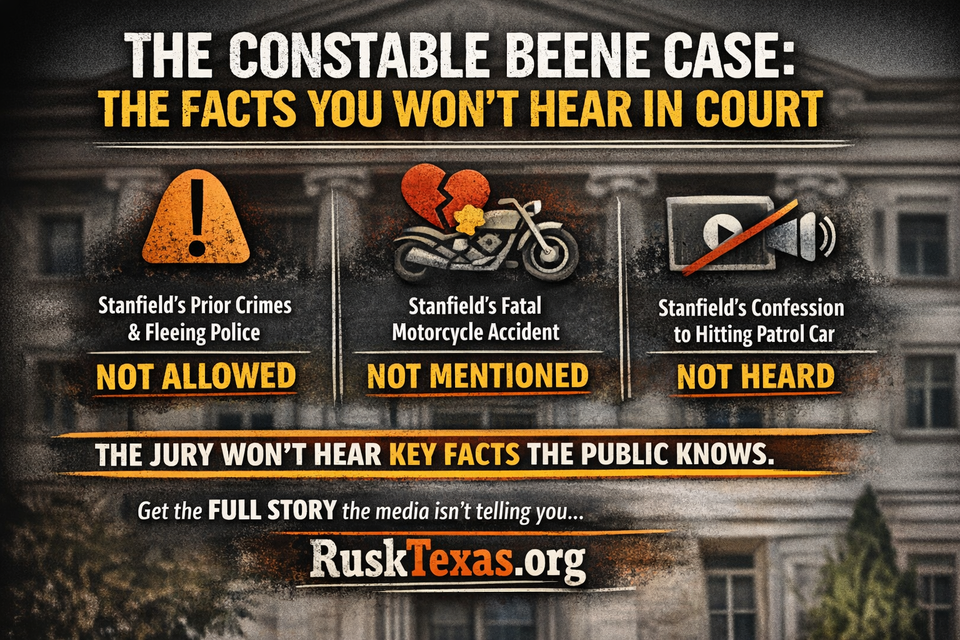
While much of the public discussion has included Stanfield’s criminal history and his death in a later motorcycle incident, the jury will not be permitted to consider those facts when determining Constable Beene’s guilt or innocence.
Under Texas rules of evidence:
- The jury will not hear about Stanfield’s prior offenses, including earlier incidents involving fleeing law enforcement with vehicles or motorcycles.
- The jury will not be told that Stanfield later died while fleeing police again, nor that his girlfriend and unborn child were involved in that fatal incident.
- The jury will not hear the contents of the recording in which Stanfield reportedly admitted to intentionally colliding with Beene’s patrol vehicle — the same recording whose nondisclosure resulted in the 2024 mistrial.
This does not suggest wrongdoing by the court — it reflects the narrow scope within which jurors must operate, compared to the broader public narrative.
Why Context Matters
Much of the coverage surrounding this case has focused on whether Constable Beene violated “pursuit policies,” often citing academic commentary. But as an elected official, Beene is not governed by a city police department or sheriff’s office policy manual. The case is not about employment discipline or internal procedures — it is about whether Beene’s conduct constituted a criminal act under Texas law.
Equally important are the facts often omitted from public discussion:
- The video does not show the actual impact
- The case already resulted in a mistrial due to undisclosed evidence
- The alleged victim had a documented history of fleeing law enforcement
- Trial delays were caused not only by investigation omissions, but also by prosecutorial licensing issues
Together, these facts paint a picture not of a simple use-of-force case, but of a deeply procedural, legally complex prosecution.
A Growing Concern About Coverage
In recent weeks, several stories surrounding this case have contained inaccuracies or omitted critical context. Many in the community now believe that certain coverage reads less like neutral reporting and more like narrative advocacy.
When key facts — such as procedural failures, evidentiary issues, and the legal authority of an elected constable — are consistently absent, the result is not a complete public understanding of the case.
This trial deserves scrutiny. But it also deserves balance.
Final Thought
The jury will ultimately decide whether Constable
Beene’s actions were criminal under Texas law. That decision should be based on evidence, legal standards, and full context — not partial narratives or selectively framed facts.
In a case this serious, the public deserves the whole story.